Your immersion suit may look serviceable and still fail when it matters most. That is why this equipment deserves more than a routine box-tick inspection. This guide is written for onboard officers who want a practical method to inspect immersion suits properly, understand what inspectors are really looking at, and keep the vessel ready for PSC, flag state, USCG, and SIRE 2.0 inspections.
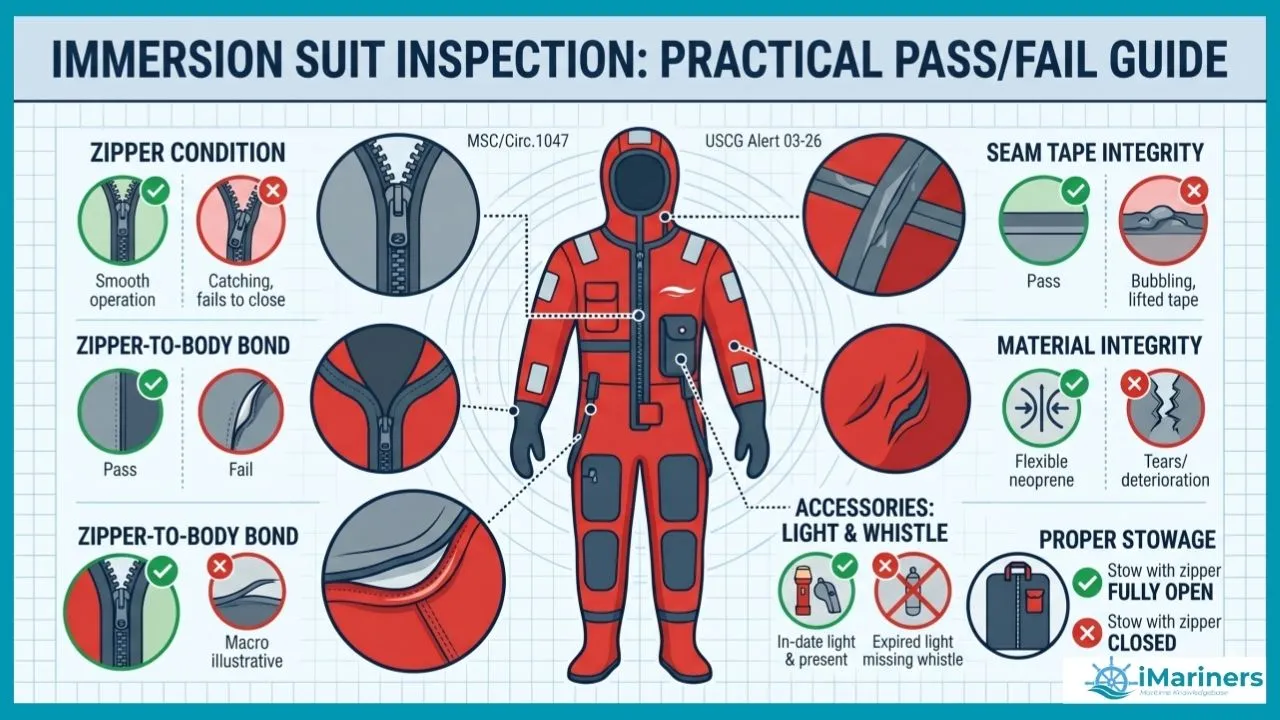
Recent industry guidance has reinforced the same point. The U.S. Coast Guard Safety Alert 03-26 highlights repeated cases of adhesive failure between the main zipper and the suit body, along with seam and closure deterioration that may not always be detected in a quick visual inspection. Lloyd’s Register has also reminded operators that monthly immersion suit examinations under SOLAS III/20.7.2 must be carried out carefully and in line with the manufacturer’s instructions, with further guidance commonly taken from MSC/Circ.1047 and MSC/Circ.1114.
Most important resource
The most useful part of this article is the Immersion Suit Monthly Inspection Checklist.
Download it and keep it handy for your next monthly inspection, PSC visit, or onboard safety check.
Why immersion suits are failing onboard
Immersion suits rarely become defective without warning. In most cases, deterioration develops slowly through poor storage, age, wrong lubricant use, contamination, rough handling, or missed periodic testing. By the time the defect becomes obvious, the suit may already have lost watertight integrity.
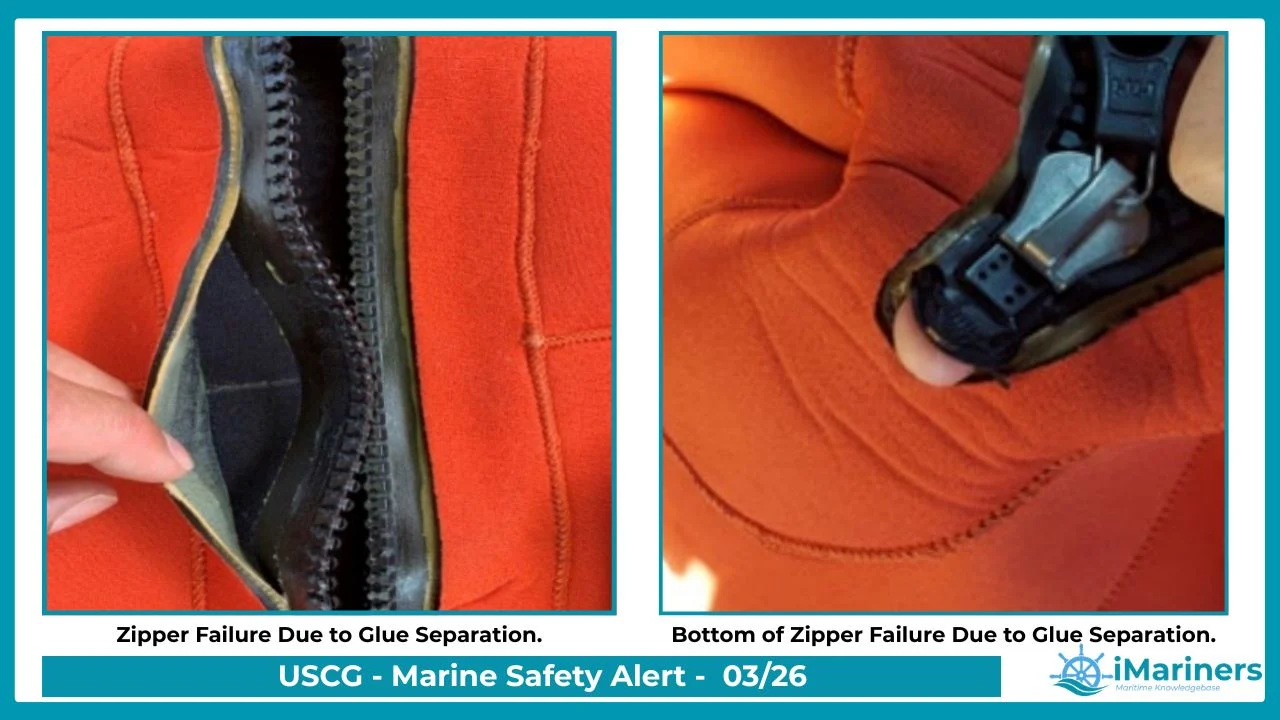
The main zipper is one of the highest-risk areas. The USCG safety alert identifies repeated findings of adhesive failure at the zipper-to-suit connection, as well as damage linked to improper maintenance products, including petroleum-based lubricants and scented powders. The same alert also recommends storing suits with zippers fully open and subjecting suits to periodic air pressure leak testing at least every three years.
Seam-taped areas such as gloves, boots, and hood attachment points are also common failure points. Lloyd’s Register has warned that even suits only a few years old have shown zipper sealant failures, which means age alone should never be used as proof that a suit is still fit for service.
What inspectors are actually checking
USCG: Inspectors focus closely on zipper condition, zipper-to-body adhesive integrity, seam-taped areas, signs of delamination, approved lubricant use, storage condition, testing intervals, and whether defective suits have been removed from service. The Coast Guard also notes that some failures are not obvious during routine visual examination, which is why pressure testing remains important.
Flag state and class: Monthly inspections are generally expected to follow the principles in MSC/Circ.1047, while periodic testing of seams and closures is guided by MSC/Circ.1114. Lloyd’s Register specifically reminds operators that defective suits should be replaced if they are not serviceable, and that repairs should follow documented manufacturer procedures.
PSC: Port State Control will usually look at immersion suits as a direct compliance item under SOLAS Chapter III. The usual questions are simple: are the suits present, accessible, complete, serviceable, and supported by proper records. Defects in condition, expired accessories, or poor records are all avoidable deficiencies when monthly checks are taken seriously.
SIRE 2.0: OCIMF has replaced the old static questionnaire system with a digital, risk-based inspection model. SIRE 2.0 inspections are built from a question library and completed in real time through a compiled vessel inspection questionnaire, which means there is no longer a single fixed VIQ in the old sense. That matters because officers are now assessed not only on the equipment itself, but also on their practical knowledge, consistency, and the credibility of what they say during inspection.
Read also: Immersion Suit Requirement as Per SOLAS
Recurring deficiencies officers should expect to be challenged on
- Adhesive failure between zipper and suit body.
- Zipper not operating smoothly or not fully sealing.
- Seam tape lifting, bubbling, peeling, or separating.
- Damage at gloves, boots, or hood attachment points.
- Rips, tears, punctures, abrasion, or material deterioration.
- Expired, missing, or defective lights and batteries.
- Missing or damaged whistle.
- Improper storage, especially suits re-stowed with zippers closed.
- Use of non-approved lubricant or contaminating products.
- Air pressure testing overdue or not documented.
- Incomplete inspection, servicing, repair, or replacement records.
- Defective suits retained onboard as though they are still available for use.
How to verify serviceability in practical terms
This is the part many officers miss. It is not enough to say “check the zipper” or “check the seams.” Officers need a practical pass/fail approach.
Zipper: how to judge pass or fail
- Pass: the zipper runs through its full travel smoothly, closes completely, and shows no lifting, gap, or glue separation along the zipper-to-body joint.
- Fail: the zipper catches, skips, does not align properly, does not close fully, or shows any sign of bond separation, distortion, or sealing damage.
Seams and taped areas: how to judge pass or fail
- Pass: seam tape is flat, well bonded, flexible, and continuous with no bubbling, peeling, or edge lift.
- Fail: any lifted edge, bubbling, delamination, cracking, peeling, or visible seam separation at gloves, boots, hood, or body joints.
Accessories: how to judge pass or fail
- Pass: light is fitted and in date, battery status is acceptable where applicable, whistle is present, and reflective tape is properly attached.
- Fail: expired or missing light, missing whistle, loose reflective tape, or accessory condition that makes the suit incomplete for emergency use.
Overall suit condition: how to judge pass or fail
- Pass: material remains flexible, intact, and free from tears, punctures, unusual swelling, brittleness, or contamination.
- Fail: any damage or deterioration that could affect watertight integrity or safe donning in an emergency.
Officer’s onboard inspection guide
1. Check stowage and identification
- Confirm the suit is in the correct location and immediately accessible.
- Check the bag for damage and ease of opening.
- Ensure donning instructions are visible and legible.
- Check that the suit type and size match the stowage label.
- After inspection, re-stow the suit with the zipper fully open.
2. Lay the suit out and inspect the body
- Use a clean, flat, dry surface.
- Check for cuts, tears, punctures, worn areas, swelling, stiffness, brittleness, discoloration, or unusual texture.
- Pay special attention to folds, corners, knees, wrists, ankles, boots, and hood joints.
3. Inspect the zipper properly
- Run it through its full travel.
- Check for smooth operation and full closure.
- Inspect both sides of the zipper-to-suit bond line carefully.
- Use only the lubricant specified by the manufacturer.
- Never use petroleum-based products, general oil spray, grease, or scented powders.
4. Inspect seam-taped areas closely
- Check gloves, boots, hood attachment, and all seam-taped areas.
- Look for bubbling, lifting, cracking, peeling, or separation.
- Flex suspect areas gently and recheck the bond line.
5. Check all accessories
- Check light condition and expiry.
- Check whistle presence and condition.
- Check reflective tape adhesion.
- If fitted, inspect the inflatable head support or buoyancy ring and its inflation hose.
6. Use the inspection as a donning awareness opportunity
MSC/Circ.1047 makes clear that monthly inspection periods are also an opportunity for crew to practice donning. That matters in tanker trade, because under SIRE 2.0 an officer who cannot explain or demonstrate immersion suit readiness may create a wider impression of weak safety management.
7. Record what was done
- Record the date, suit number or location, condition found, defect noted, action taken, and inspector’s name.
- Keep servicing, replacement, and repair records available.
- If the number of serviceable suits falls below requirements, escalate immediately through the Master and company procedures.
“Some immersion suits are stored in airtight packaging, and in that case the monthly check focuses on the packaging integrity and visible condition rather than opening the suit itself. Follow the manufacturer’s instructions and company procedures for the exact storage method onboard.”
Pressure testing: what it checks and why it matters
Pressure testing is what confirms the suit still holds integrity when visual inspection is no longer enough. MSC/Circ.1114 gives guidance for periodic testing of immersion suit and anti-exposure suit seams and closures, including inflation of the suit and checking for leakage at a defined low pressure range. In practical terms, the test is there to reveal seam and closure failures that may not be visible during normal handling.
For officers onboard, the key point is not to improvise the test. Follow the manufacturer’s procedure and your company system, and ensure the interval is kept current. Published guidance commonly refers to testing at intervals not exceeding three years, with more frequent testing for older suits.
When a suit should be removed from service
- Non-functional zipper.
- Adhesive separation at zipper-to-body joint.
- Seam failure, delamination, tape lifting, or visible bond failure.
- Tear, puncture, or significant material deterioration.
- Missing, expired, or defective critical accessories that cannot be replaced immediately.
- Leak found during pressure testing.
- Evidence of contamination or improper maintenance product use.
The USCG alert recommends that non-functional suits be removed from service and repaired only by an authorized repair station. Lloyd’s Register also states that defective suits should be replaced unless there is an acceptable manufacturer-approved repair process.
Custom pre-inspection checklist for ship’s officers
- Confirm the number of serviceable immersion suits matches certificate requirements.
- Open every bag and inspect every suit; do not rely on spot checks.
- Verify zipper function and zipper-to-body bond on each suit.
- Inspect seams, seam tape, gloves, boots, and hood attachment points.
- Check light, battery, whistle, and reflective tape condition.
- Confirm correct storage and re-stowage with zippers fully open.
- Check that only approved lubricant is being used onboard.
- Verify periodic pressure testing records are current.
- Review defect history, repairs, and replacements.
- Ensure officers can explain the inspection routine clearly during PSC or SIRE 2.0 interaction.
Download the Monthly Inspection Checklist
To make onboard inspections easier, I have prepared a practical monthly inspection checklist and inventory register that officers can use for shipboard control, recordkeeping, and inspection readiness.
- Download Monthly Inspection Checklist (PDF)
- Download Immersion Suit Monthly Inspection Checklist (Excel)
Use this checklist during monthly inspections and keep the records onboard for PSC, flag state, USCG, and internal audits.
Real-Life Lesson from Onboard Experience
When I joined a vessel in dry dock as Third Mate, the immersion suits had already been annual serviced ashore just a few days earlier. At first, I assumed they would be in good condition, but a physical inspection told a different story.
Out of 33 immersion suits, I had to remove 21 from service because several were badly worn and some rubber gloves tore easily during checking. Fortunately, the vessel was still in yard and replacements were arranged in time. That experience reinforced one clear lesson: never trust records alone — always inspect every immersion suit physically.
Final Thoughts
Immersion suits should never be treated as a paperwork item alone. A proper onboard inspection, correct storage, and current pressure-testing records are what keep the equipment truly serviceable.
Use the checklist, maintain the inventory register, and update both after every service, repair, replacement, or defect found onboard. That is what keeps the suit ready before it is needed in an emergency.